
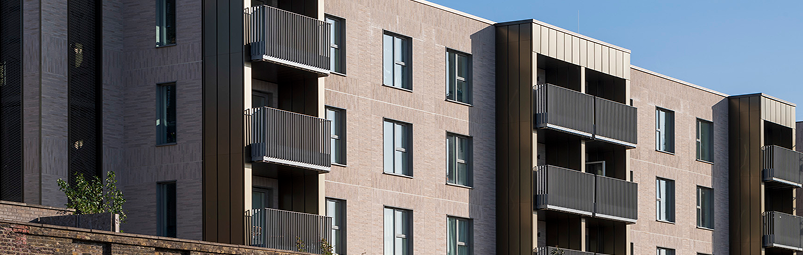
Design for Manufacture and Assembly (DfMA) principles are transforming façade delivery inside the offsite construction sector, with Mauerwall providing a perfect example of how to streamline it across low-rise installation.
Modern methods of construction (MMC) have transformed how low-rise housing is delivered. Structural frames, floors and roofs are now precision-engineered in controlled factory environments, yet the facade has often remained the final hold-out – reliant on on-site trades and good weather. For manufacturers pursuing end-to-end certainty, that dependency introduces delay, cost, and inconsistency.
As MMC continues to scale, with panelised and modular systems now delivering thousands of homes annually, the pressure to integrate every element of the build process is intensifying. Policy drivers such as the Future Homes Standard and carbon reduction targets are accelerating this shift, making facade modernisation an operational necessity rather than a design preference.
The industry’s next step lies in re-engineering the building envelope itself. By embodying DfMA principles within its design, Mauerwall closes the loop between factory production and on-site assembly by transforming the facade from a traditional site activity into a precision-manufactured component.
From process to product
Developed specifically for offsite manufacture, the A2-s1-d0 non-combustible façade uses a mineral-polymer compound with natural aggregates to recreate the character of traditional brickwork in a lighter, more consistent format. Each Mauerwall panel incorporates pre-formed corners, reveals and castellations, allowing architectural detailing to be designed in at the mould stage rather than added on-site.
“By engineering the facade as a repeatable component, we remove uncertainty from installation and gain the same consistency that offsite manufacturers already achieve with walls, floors and roofs,” says Krishan Pattni, Chief Design Officer at Mauerwall.
Designed for DfMA workflows
Mauerwall kits are pre-engineered to align precisely with timber frame, structural insulated panels (SIP) or light steel frame superstructures. Fixing locations and tolerances are planned in advance, allowing panels to be positioned and secured without cutting, drilling or extensive adjustment on site.
Because the system is pre-pointed and dry-fixed, installation becomes largely weather-independent – a major advantage in maintaining programme certainty. Less scaffolding, fewer trades and shorter installation cycles all translate into safer sites and predictable sequencing. The simplified assembly also enhances safety and workforce efficiency, cutting man-hours at height and reducing the need for specialist bricklaying labour that remains in short supply across the sector.
“On live housing schemes we’ve seen façade installation times reduced by more than half compared with conventional brickwork,” adds Krishan Pattni. “That speed allows developers to hit handover dates even when weather would usually halt progress.”
Assurance built in
Performance verification remains critical in an increasingly regulated marketplace. Mauerwall holds KIWA BDA certification, confirming a 60-plus-year design life and Category 1 impact resistance for ground-floor and public realm applications. It has been independently tested to achieve the A2-s1-d0 fire rating required for residential and public buildings. Sustainability credentials are equally robust: Mauerwall delivers up to 50% lower embodied carbon than a traditional brick-facing wall. Panels are factory-batched for material efficiency and incorporate recycled aggregates without compromising finish quality. Lightweight logistics reduce vehicle movements and on-site waste.
Proven in practice
Mauerwall has already been deployed across several large-scale offsite housing projects, including Civic Living at Houlton and Kitchener Barracks Apartments in Chatham. On both schemes, facade panels were manufactured and installed alongside timber superstructures, maintaining architectural consistency while accelerating delivery. The controlled process also reduces site waste and minimises defects typically associated with hand-laid masonry.
Site installation teams have reported faster sequencing and clean finishes, with panels requiring minimal adjustment once fixed in place. Further residential phases are now progressing as housebuilders integrate the system into wider development programmes. Housebuilders have cited programme reliability and aesthetic fidelity as key benefits. “It’s the combination of speed, compliance and visual quality that’s changing perceptions,” says Krishan Pattni. “Once contractors see how seamlessly the panels integrate with their build systems, they recognise it as an engineering solution and not just an alternative cladding.”
The next phase of offsite delivery
DfMA thinking is reshaping how the industry approaches every element of a building, and facades are no exception. Systems like Mauerwall demonstrate that performance, precision and design ambition can coexist within a fully industrialised process. By treating the building envelope as a manufactured product rather than a site activity, offsite contractors gain greater control over quality, carbon and cost – while designers retain the freedom to specify the brick aesthetics the UK housing market still demands. As Krishan Pattni says: “The facade is no longer the weak link. With the right engineering approach, it becomes one of the strongest enablers of true modern construction.”
To find out more about Mauerwall, get in touch